What temperature do worms like — red wigglers thrive at 55 to 77 degrees Fahrenheit

What Temperature Do Worms Like? (55–77°F Guide)

What temperature do worms like? Red wigglers like 55 to 77°F, and they do their best work between 60 and 70°F. In that range they eat well, breed steadily, and turn scraps into castings in about 60 to 90 days. Below 55°F they slow down, and above 77°F they get stressed — and a hot […]
Read more →

Worm bin for apartments — a tote under the kitchen sink

Worm Bin for Apartments: Small-Space Setup

A worm bin for apartments works in a space as small as a kitchen cupboard — no garden, balcony, or garage needed. A 10-gallon tote fits under the sink, in a closet, or beside the fridge, and turns kitchen scraps into castings for houseplants and pots. Setup costs under $30, plus $20 to $40 for […]

Read more →

How long do red wigglers live — a red wiggler worm with a clock

How Long Do Red Wigglers Live?

How long do red wigglers live? In a home worm bin, about 1 to 2 years. In ideal conditions — steady temperature, damp bedding, regular food — some live up to 4 years. In a bad bin they may last only a few months. What matters most is the population: a healthy bin replaces its […]

Read more →

What is vermicompost — worm castings in dark soil with a seedling

What Is Vermicompost? (Castings vs Compost Explained)

What is vermicompost? It is compost made by worms. Red wigglers eat kitchen scraps and bedding, and what comes out the other end is vermicompost — dark, crumbly, earthy-smelling castings that feed garden soil. It is finished compost, made slowly, in a bin, by worms. Vermicompost, worm castings, and worm compost are used as if […]

Read more →

Why are my worms escaping from the worm bin

Why Are My Worms Trying to Escape?

Why are my worms escaping? Usually, something in the bin is wrong — too wet, too dry, too hot, too cold, or too acidic. Worms do not leave a good bin. The cause is usually one of four things; find it in ten minutes. Red wigglers love damp, dark bedding and steady food. When they […]

Read more →

Illustration of a watering can pouring worm tea on plants

How to Make Worm Tea (and How to Use It)

How to make worm tea? Soak 1 cup of finished worm castings in 1 gallon of water for 24 hours, stir a few times, strain out the solids, and use it the same day. Dilute it 1 part tea to 1 part water, and pour it on the soil around your plants — never on […]

Read more →

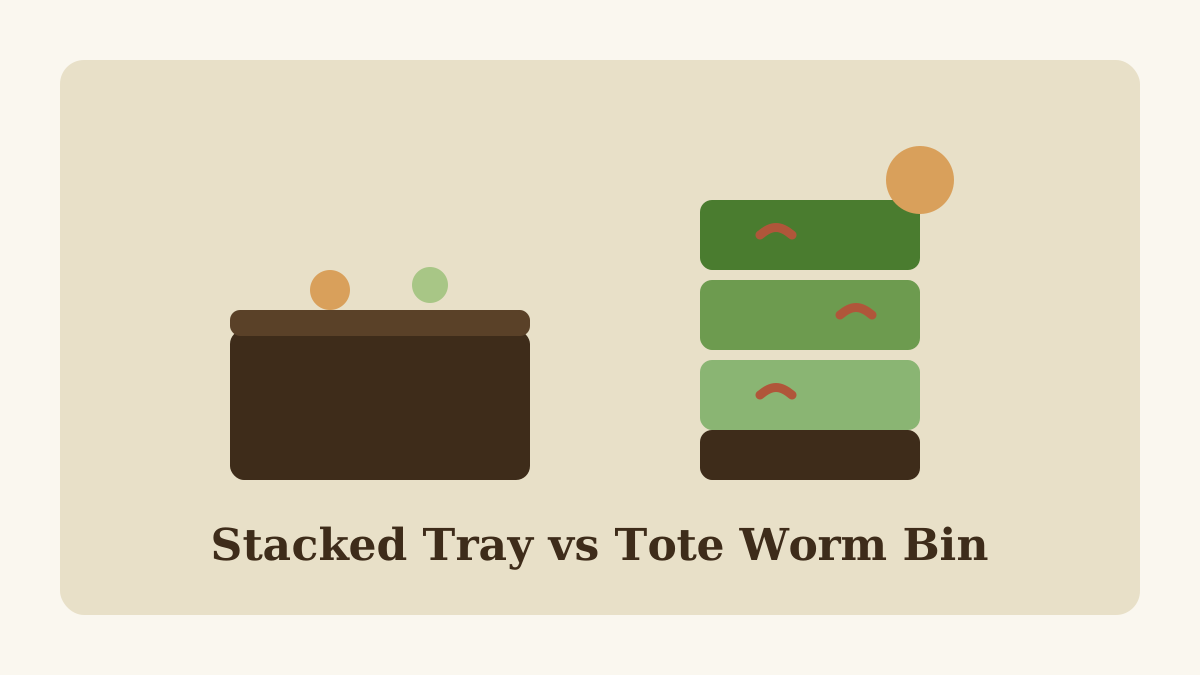
Illustration comparing a stacked tray worm bin with a tote worm bin

Stacked Tray vs Tote Worm Bin: Which Is Better?

Stacked tray vs tote worm bin — which should you buy? Start with a tote. A DIY tote bin costs under $30, holds 1 to 2 lb of red wigglers, and teaches you the whole system. A stacked tray bin costs $80 to $150, but it makes harvesting much easier, because the worms move up […]

Read more →

Illustration of a worm bin in winter with snowflakes, keeping worms warm indoors

Worm Bin in Winter: How to Keep Worms Alive

Worm bin in winter comes down to one move: bring the bin inside before the first freeze. Red wigglers thrive at 55 to 77°F, slow down below 55°F, and stop eating below 50°F. A bin left outside in freezing weather freezes solid, and frozen worms do not recover Winter kills more worm bins than any […]

Read more →

Illustration of a cup of coffee grounds beside a worm bin, showing coffee grounds for worms

Can Worms Eat Coffee Grounds? (And How Much)

Can worms eat coffee grounds? Yes — red wigglers eat used coffee grounds happily, and the grounds even help the bin. But coffee is a seasoning, not a meal. For a settled bin with 1 lb of worms, about 1,000 worms, the safe amount is about 1 tablespoon of grounds per feeding, mixed into the […]

Read more →

☎ Book Now